
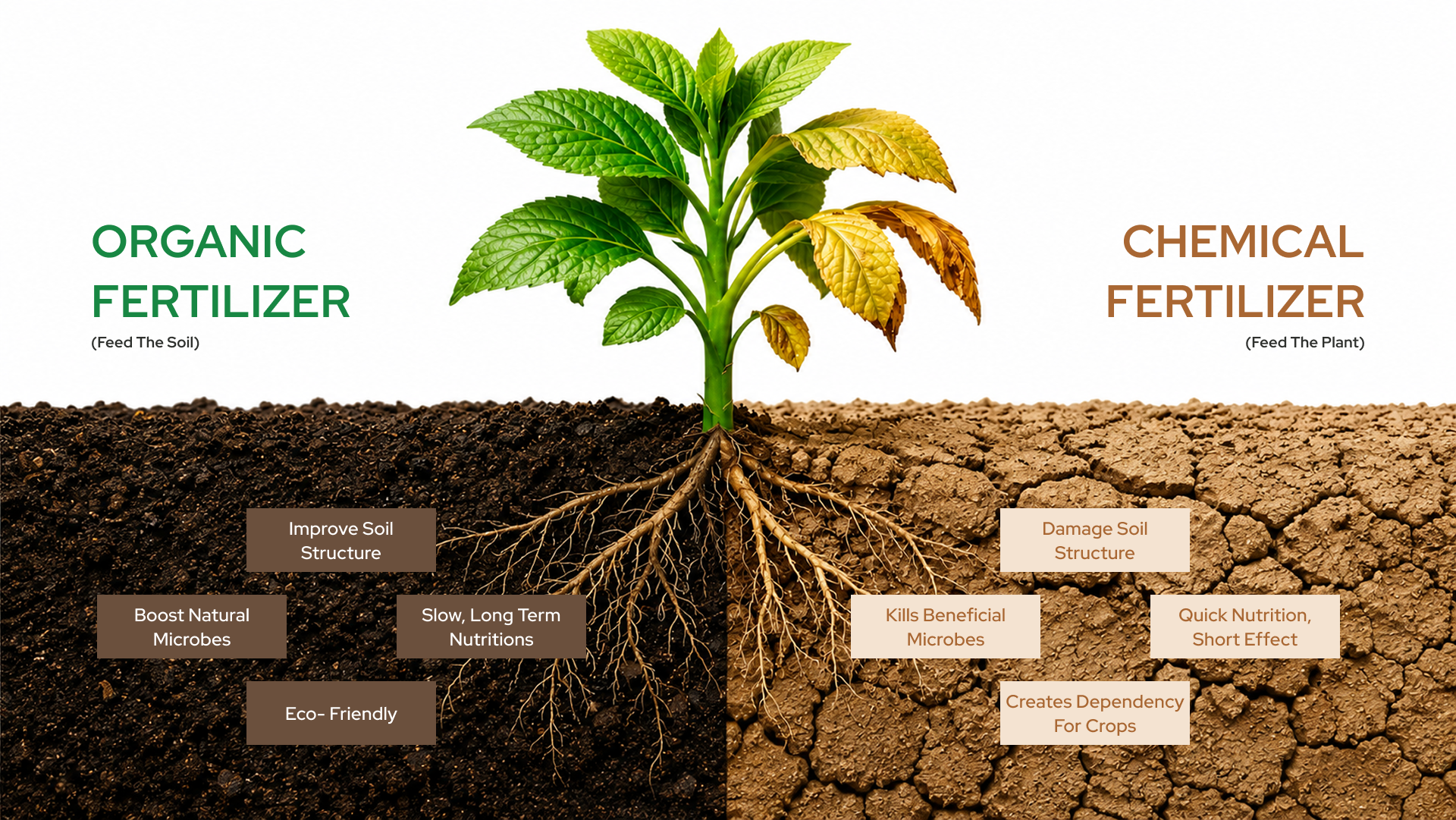
There is a schism in the agricultural community over the use of organic fertilizers vs. synthetic ones. The age-old debate has roots that run deep, with proponents on both sides defending their chosen methods. Organic fertilizing products, derived from natural sources like decomposed plant matter or animal waste, offer a gentle and sustainable approach to soil enrichment. In contrast, synthetic fertilizers provide a potent blend of chemical compounds, promising immediate results but raising questions about their long-term effects. This article explores the intricacies of this ongoing organic vs. synthetic fertilizer discussion, offering insights and tools to help you navigate the world of crop nourishment.
TESTED QUALITY. BETTER SOIL. STRONGER CROP GROWTH.
Key differences between Smiling Crops V/S Other Brand
| Feature | Smiling Crops Organic Fertilizer | Other Brand Organic Fertilizer |
|---|---|---|
| Quality assurance | Lab-tested formulation with defined nutrient and microbial data | Quality and composition may vary from brand to brands |
| Nutrient strength | Strong nutrient values highlighted in test data — e.g. FOM N 2.14%, P 2.62%, K 2.13%; LFOM N 6.38%, P 2.06%, K 1.83% | Nutrient levels may differ and may not always be clearly communicated |
| Organic carbon | High organic carbon support — FOM 22.8% and LFOM 47.29%, which helps long-term soil health | Organic carbon level may vary by formulation |
| Microbial support | Contains beneficial bacterial count data, including N-fixing, P-solubilizing and K-mobilizing bacteria | Microbial count/support may not always be specified |
| Effect on soil | Helps improve soil structure, supports soil fertility, and maintains soil organic carbon | May provide organic nutrition, but long-term soil improvement depends on the brand and composition |
| Crop suitability | Recommended for all crops and can be used at any crop stage | Crop suitability may vary by product |
| Application support | Clear usage guidance available: 5 liters per acre, dilute 1:50, suitable for drip/drenching | Application instructions may differ and may be less detailed |
| Farmer confidence | Backed by presentation + lab test data, making it easier to communicate trust | Farmers may need to check each brand separately for proof and consistency |
